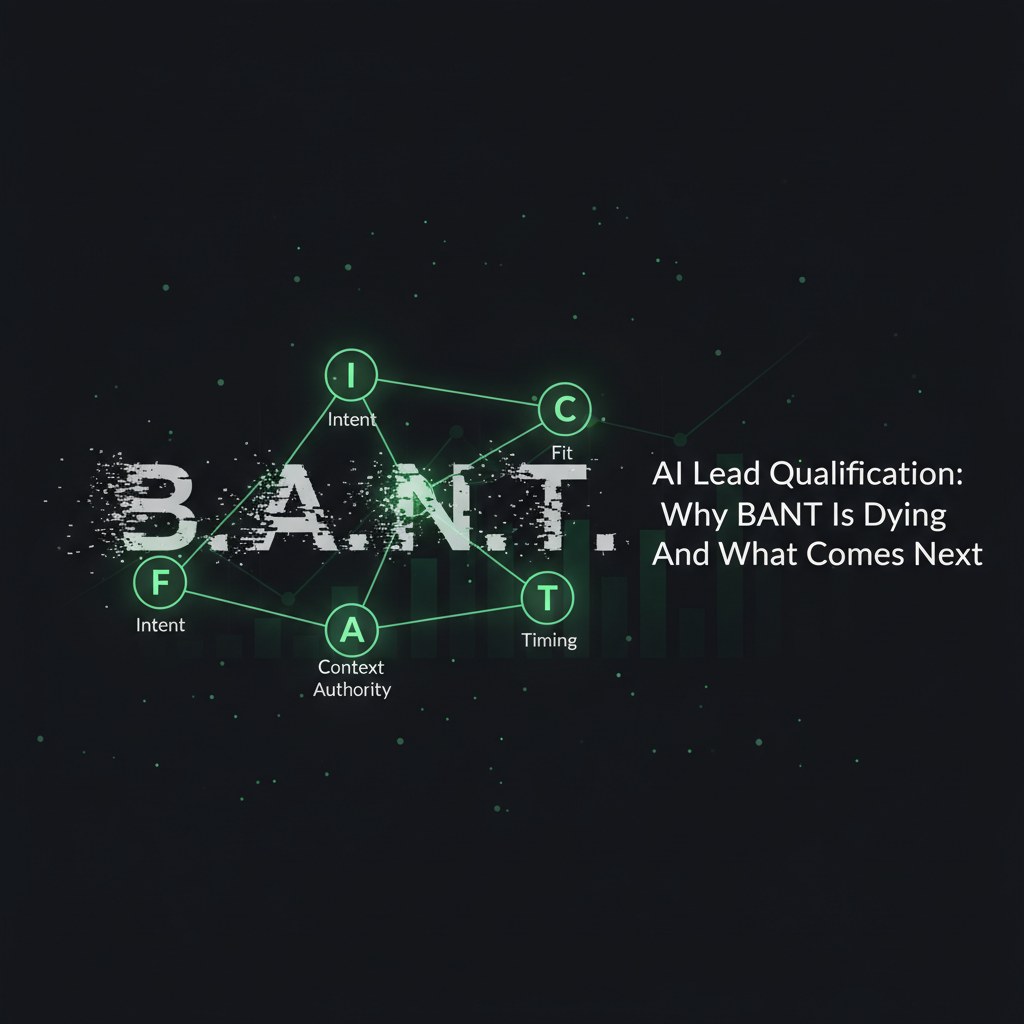
- BANT was built for 1960s IBM telephone sales cycles. Its assumptions collapse in a 2026 WhatsApp conversation where you have 20 seconds and 15 words to work with.
- Five failure modes: distributed authority, flexible budgets, vague needs, compressed timelines, and qualification windows measured in seconds.
- Conversio's replacement is IF-CAT: Intent, Fit, Context, Authority, Timing. Built for signal extraction from short conversational messages.
- Deterministic scoring beats additive scoring. Same inputs, same score, recalculated from state, not accumulated from events.
Your lead just asked about pricing in a 15-word WhatsApp message. What are you scoring them on?
If your answer involves a multi-field CRM form or a 40-minute discovery call, your qualification system is running on 2015 assumptions. In 2026, across SA businesses on WhatsApp (dealerships, estate agencies, insurance brokers), the qualification window is measured in seconds. Three lines. Score them or lose them.
What BANT measured
BANT (Budget, Authority, Need, Timeline) was codified by IBM in the 1960s for enterprise software sales: 9-12 month cycles, single telephonic discovery calls, senior B2B buyers with signing power. In that world, Budget gated affordability, Authority confirmed decision-makers, Need validated the problem, and Timeline managed forecasting. Every dimension was extractable in 40 minutes of engaged conversation.
None of those conditions hold in 2026 on WhatsApp.
Where BANT breaks
1. Authority is distributed. Gartner research shows modern B2B purchases involve 6-10 stakeholders. In SA SMEs, the person WhatsApping about car finance might be the driver but needs a spouse's input on the instalment.
2. Budget is more flexible than BANT assumes. Dealer finance, salary advances, and split-payment options have changed the budget question. "I can't afford it" often means "I haven't explored finance yet."
3. Need is discovered, not declared. HBR research shows buyers rarely arrive with articulated problems. They arrive with symptoms. "Hi looking for a car" is an invitation, not an absence of need.
4. Timeline has compressed. Salesforce State of Sales shows decisions that took weeks now happen in hours. In automotive and property, a Saturday morning WhatsApp often commits by Saturday afternoon.
5. Qualification is the conversation itself. BANT was built for a world where qualification was a discrete event. On WhatsApp, qualification is continuous. Every message is a data point.
At three messages you have fewer than 100 words. BANT was built for 4,000.
IF-CAT: the AI-native framework
IF-CAT is not a checklist. It is a set of signal dimensions detected continuously from unstructured conversational input.
Intent: language signals in the opening message. "Is the Ranger available in double cab with canopy?" is different from "hi info please." An AI distinguishes them in under a second.
Fit: vertical template matching. Does the lead's product interest, location, and use case match the profile that converts in your vertical? Evaluated against criteria defined per vertical.
Context: structured data the conversation surfaces (budget range, product name, location, units). These populate columns, not notes.
Authority: inferred from language. "We are looking at options" signals group decision. "I want to place the order today" signals primary authority with intent.
Timing: recency and cadence. A lead who replied 90 seconds after the AI is on a different urgency curve from one who went silent four days ago.
Deterministic scoring beats additive
The most common AI lead scoring failure is the additive model: 15 points for opening an email, 20 for a click, 25 for a form. Scores accumulate. After enough events, the lead is "qualified".
The problem is score inflation. A lead who clicked three emails in one session can outscore a lead who sent one precise enquiry with budget and date. Gartner research finds additive models have false-positive rates of 40-60%. Sales teams stop trusting the scores.
The alternative is simple: the agent scores each lead on five things, recalculated fresh every time the lead updates. How clear is the intent in the message. How well does the lead match your vertical. Do we know the budget. Is this the decision-maker or a researcher. How recent is the last reply. Each signal carries a weight, the total lands between 0 and 100, and the same lead produces the same score every time.
Score is state, not history. When a lead goes cold for 48 hours, the recency component drops. The number reflects what is true right now, not what someone clicked on last month.
Additive scoring creates a leaderboard of activity, not a ranking of intent. If your top scores are the clickers rather than the askers, your model is telling you the wrong thing.
What the agent does with the score
Above the hot-lead threshold (typically 60/105), the system routes the lead to the highest-available agent with a full context summary: name, product interest, budget, intent signals, authority, last reply. The agent continues a conversation rather than reconstructing one.
Below the threshold, the AI continues the nurture: clarifying questions, relevant product info, or an open door. The lead is parked, not abandoned.
Zara, Sales Agent
Online now
Type a message...
The handover summary is the underrated half of AI qualification. Capturing the score matters. Giving the human agent a clean brief at handover is what turns qualification into conversion.
30-day adoption
Week 1: Instrument inbound. Tag every lead with vertical, source, and first-message intent. Build a baseline. Label 50 real first messages.
Week 2: Define fit criteria. For each vertical, write down three to five criteria that mark a strong fit.
Week 3: A/B test thresholds. Set initial hot-lead threshold at the top 20%. Run alongside existing process for a week. Adjust.
Week 4: Codify handover rules. Define exactly which structured columns must be populated before an agent sees the lead.
For the WhatsApp channel case, see why WhatsApp beats email. For dealerships, the car dealership playbook. For POPIA, the compliance guide. For voice, why AI voice beats IVR.
Frequently asked questions
- Is BANT completely obsolete?
Not obsolete, misapplied. BANT still works for long-cycle enterprise B2B with structured discovery calls and a senior buyer. It breaks down in asynchronous conversational sales. For most SA SMB teams, that describes the majority of inbound.
- What is the difference between MQL, SQL, and an AI-qualified lead?
MQL meets a marketing engagement threshold. SQL is reviewed by a rep. An AI-qualified lead (IF-CAT) is scored deterministically against structured signal data from the conversation itself, without human review. Thresholds can approximate MQL or SQL, but the mechanism differs.
- Can AI extract authority from a WhatsApp message accurately?
With meaningful accuracy, not perfect. Language signals correlate with authority. Gartner puts authority inference at around 70-75% accuracy. Treat it as a prior, not a certainty, and keep human override available for high-value leads.
- How many data points does the AI need for a reliable score?
Minimum: intent signal (first message), vertical fit (product interest), and one context data point (budget, product, or location). Achievable within two to three messages. Reliability improves as authority and timing fill in, typically by message four or five.
- Should humans override AI scores?
Yes, always. The score is a prioritisation tool, not a decision. Salespeople should override based on context the AI cannot detect: recent event conversations, company circumstances, or vertical cues. Make the score the starting point, overrides the exception.
- How does IF-CAT differ from MEDDIC?
MEDDIC is enterprise, multi-stakeholder, long-cycle. Even more call-intensive than BANT. IF-CAT is optimised for short conversational messages and async WhatsApp threads. MEDDIC asks a salesperson to extract six dimensions over calls. IF-CAT asks the AI to detect five signal types from natural flow.
About the author: Murali Naidu is the founder of AmbitX.ai and builder of Conversio, a WhatsApp-native CRM for SA sales teams. He has spent three years building AI qualification systems for dealerships, estate agencies, and B2B businesses across South Africa.
Tagged